Raising Creative Thinkers in an AI-Dominated World

Technology shapes nearly every part of modern life, and artificial intelligence now plays a major role in education, work, communication, and entertainment. Children grow up with instant access to information, smart assistants, and automated tools that can answer questions within seconds.
While these tools offer convenience, they can also reduce opportunities for independent thinking if families depend on them too much. Creativity remains one of the most valuable human skills because it allows people to imagine new ideas, solve problems, and create original solutions.
Parents and educators face a new challenge: helping children develop imagination and curiosity while living in a technology-driven environment. Raising Creative Thinkers in an AI-Dominated World requires a balance between technology use and real-life experiences that encourage exploration, experimentation, and original thought.
Raising Creative Thinkers in an AI-Dominated World
Creativity does not appear by chance. Children develop creative thinking through experiences that encourage curiosity, questioning, and problem-solving. Parents can create an environment where imagination grows naturally.
Encourage Open-Ended Questions
Children often ask questions about how things work. Instead of giving direct answers every time, encourage them to think.
Examples include:
- What do you think will happen?
- Why do you think that works?
- Can you think of another solution?
- What would you do differently?
Open-ended discussions help children build confidence in their own ideas.
Allow Time for Unstructured Play
Many children spend most of their day following schedules. Creative thinking often develops during free play.
Activities that support imagination include:
- Building with blocks
- Creating stories
- Drawing and painting
- Pretend play
- Outdoor adventures
Unstructured activities give children space to invent, experiment, and discover.
Limit Dependence on Instant Answers
AI tools can provide answers immediately. Constant reliance on them can weaken problem-solving habits.
Parents can encourage children to:
- Research independently.
- Brainstorm several solutions.
- Test ideas through experiments.
- Discuss findings with others.
This process develops critical thinking alongside creativity.
Encourage Creative Projects
Creative projects help children turn ideas into reality.
Examples include:
- Writing short stories
- Creating comics
- Building simple inventions
- Recording videos
- Designing board games
- Crafting handmade items
Projects teach persistence, planning, and innovation.
Celebrate Original Thinking
Children often hesitate to share unusual ideas because they fear criticism. Positive feedback encourages them to think creatively.
Parents can praise:
- Unique solutions
- New perspectives
- Effort and experimentation
- Curiosity and initiative
Recognition builds confidence and motivates children to keep exploring.
Promote Reading and Storytelling
Books expose children to different characters, settings, and ideas. Reading strengthens imagination and expands creative thinking.
Helpful habits include:
- Daily reading sessions
- Family storytelling nights
- Creating alternate endings to stories
- Discussing favorite characters
Stories encourage children to imagine possibilities beyond their immediate surroundings.
Why Creativity Matters More Than Ever
Artificial intelligence can process information quickly, but human creativity remains difficult to replace.
Creative thinkers can:
- Generate original ideas
- Adapt to changing situations
- Solve unexpected problems
- Connect unrelated concepts
- Create artistic and cultural works
Future careers will continue to reward people who bring fresh perspectives and unique solutions.
Employers increasingly value skills that machines cannot easily replicate. Creativity stands among the most important of those skills.
The Role of Technology in Creative Development
Technology itself does not harm creativity. The issue comes from how children use it.
Healthy technology use can support learning and imagination.
Positive Uses of Technology
Children can use technology to:
- Create digital artwork
- Learn music production
- Develop coding projects
- Produce videos
- Design animations
- Explore educational content
These activities encourage active participation rather than passive consumption.
Avoid Passive Screen Habits
Passive entertainment often limits creative engagement.
Parents should monitor excessive:
- Endless scrolling
- Mindless video watching
- Constant gaming without creative elements
- Automatic reliance on AI-generated content
Children benefit more when they create rather than consume.
Building a Home Environment That Supports Creativity
The home environment plays a major role in creative development.
Create a Dedicated Creative Space
Children feel more motivated when they have a space for creative activities.
A creative corner may include:
- Art supplies
- Building materials
- Books
- Craft tools
- Notebooks
- Musical instruments
The goal is easy access to materials that inspire exploration.
Encourage Curiosity Every Day
Creativity begins with curiosity.
Parents can encourage curiosity by:
- Visiting museums.
- Exploring nature.
- Trying new hobbies.
- Discussing current events.
- Conducting simple science experiments.
New experiences often spark new ideas.
Accept Mistakes as Part of Learning
Creative growth requires trial and error.
Children learn valuable lessons when they:
- Test ideas
- Make mistakes
- Revise their work
- Try again
A supportive environment reduces fear and encourages experimentation.
Teaching Problem-Solving Skills
Creative thinkers approach challenges differently. They look for multiple possibilities instead of a single answer.
Encourage Brainstorming
When children face a challenge, ask them to list several solutions.
Brainstorming helps children:
- Think flexibly
- Generate ideas quickly
- Consider different viewpoints
- Build confidence
Quantity often leads to quality when generating ideas.
Use Real-Life Challenges
Daily situations provide opportunities for creative problem-solving.
Examples include:
- Planning a family event
- Organizing a bedroom
- Designing a school project
- Creating a budget for a purchase
Real challenges make learning practical and engaging.
The Importance of Human Connection
Human interaction plays a key role in creative development.
Conversations, teamwork, and collaboration expose children to different viewpoints.
Activities that strengthen creative thinking include:
- Group projects
- Family discussions
- Community events
- Team sports
- Drama activities
Human relationships encourage empathy and perspective-taking, which often inspire creative ideas.
Preparing Children for the Future
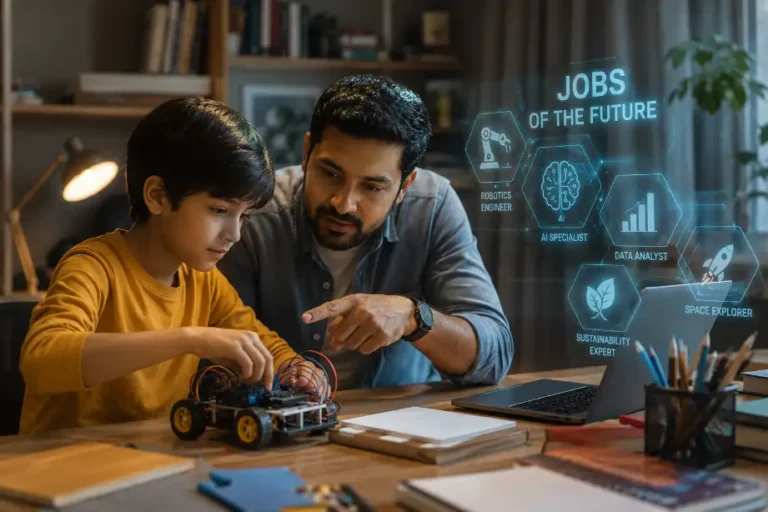
The future workplace will combine human skills with artificial intelligence. Children who develop creativity will have a strong advantage.
Parents should focus on helping children become:
- Curious learners
- Independent thinkers
- Effective communicators
- Adaptable problem-solvers
- Confident creators
These abilities will remain valuable regardless of technological changes.
Rather than competing with AI, future generations can use it as a tool while contributing uniquely human ideas and innovations.
F.A.Q
Why is creativity important in an AI-driven world?
Creativity helps people generate original ideas and solve problems that machines cannot easily handle.
Can AI reduce a child’s creativity?
Excessive dependence on AI can limit independent thinking and creative problem-solving.
How can parents encourage creative thinking?
Parents can support curiosity, free play, storytelling, and hands-on projects.
Does screen time always harm creativity?
No, creative uses of technology can support imagination and learning.
What activities improve creativity in children?
Reading, drawing, building, writing stories, and outdoor exploration help develop creativity.
How does unstructured play support creative growth?
It allows children to invent ideas, solve problems, and use their imagination freely.
What skill will remain valuable despite AI advancements?
Creative thinking will remain highly valuable because it drives innovation and original solutions.